Understanding the Real Difference Between a SAM Endorsement and a Standalone Policy
If you’ve ever seen “SAM” listed on a certificate of insurance and thought, “We’re covered,” you might want to take a closer look. Just because the certificate says “Sexual Abuse and Molestation” doesn’t mean you have meaningful protection. The real story is in the policy language itself.
In insurance, SAM stands for Sexual Abuse or Molestation coverage. It’s sometimes called Sexual Misconduct Liability or Abuse & Molestation Liability. This coverage is often required by schools, cities, youth programs, camps, and others who work with minors or vulnerable groups. But the requirement alone doesn’t say how the coverage needs to be built – and that’s where problems begin.
There are two main ways SAM coverage shows up:
1. SAM Endorsement on a General Liability (GL) Policy
This is when a standard GL policy adds an endorsement to cover sexual misconduct claims. It might:
- Fully restore coverage that a policy excludes by default (a “true” buyback),
- Offer limited protection, like only covering negligent supervision, or
- Add cosmetic language that doesn’t really override the exclusions.
These endorsements often come with limits, restrictions, or narrow definitions. Some only protect the organization if the abuser isn’t an insured person, and others may define “abuse” so narrowly that claims involving grooming or verbal misconduct fall outside the coverage.
Defense costs are another red flag. If legal fees eat into your SAM limit – especially if you only have a $100,000 sublimit – there may be little or nothing left for settlements.
2. Standalone SAM Policy
A standalone policy is built specifically to respond to sexual misconduct claims. It often includes broader definitions, higher limits, and more thoughtful handling of defense. It may also separate SAM coverage from your general liability limits, so a large abuse claim doesn’t wipe out your entire GL aggregate.
These policies are typically more expensive and may require documented procedures, background checks, or training programs. Some are also written on a claims-made basis, which adds reporting responsibilities.
Still, standalone SAM is often the better choice when:
- You work directly with minors,
- The venue contract asks for separate limits or aggregates,
- You want peace of mind around definitions, exclusions, and defense,
- Or you simply want protection that actually holds up under scrutiny.
Common Misunderstandings That Lead to Trouble
1. “It says SAM on the certificate, so we’re fine.”
Not necessarily. A certificate isn’t the contract. Only the forms show what’s truly covered.
2. SAM is included, but with a low sublimit.
Some policies list SAM, but only offer $100K in coverage – far less than most venue requirements.
3. Defense costs reduce the limit.
A $1M SAM limit doesn’t go far if defense expenses are taken from that same pot.
4. Coverage only applies to certain claims.
If your endorsement only covers negligent supervision and not the broader misconduct claim, venues may reject it.
5. The exclusion still applies.
If the SAM endorsement doesn’t clearly override the policy’s abuse exclusion, you may have no coverage at all.
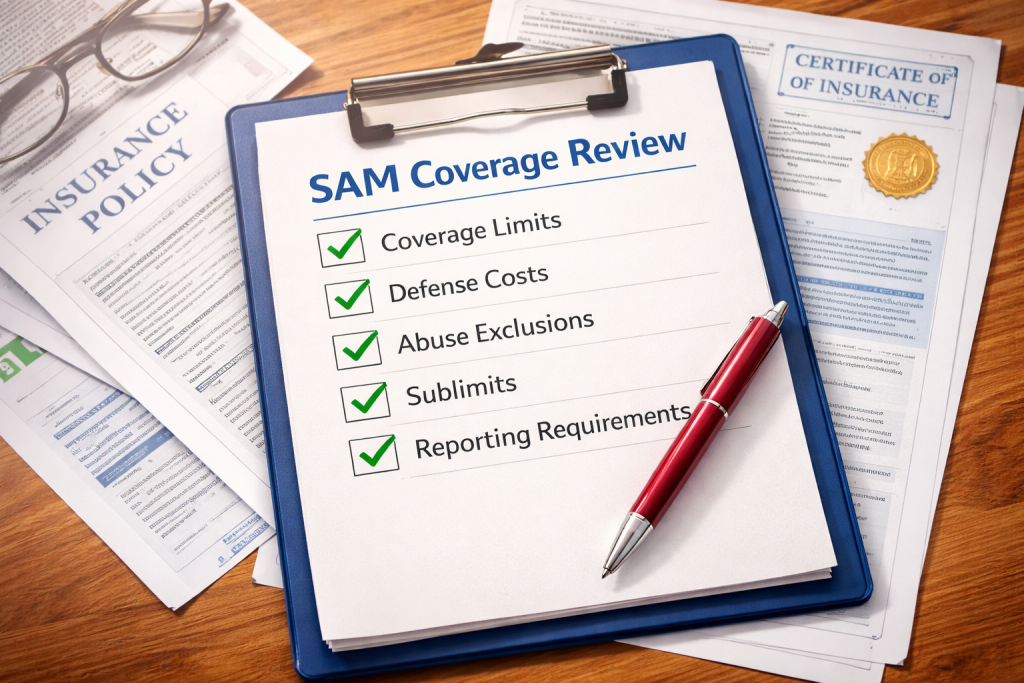
A 10-Minute SAM Coverage Checklist
When reviewing a SAM endorsement on a GL policy, confirm:
- Is there an abuse or molestation exclusion?
- If yes, is there a specific endorsement that restores coverage?
- What are the limits for SAM?
- Equal to GL limits? A small sublimit? Separate aggregate?
- How is defense handled?
- Inside or outside limits? Any restrictions on legal counsel?
- Who is covered?
- Just the organization? Employees, volunteers, coaches?
- Is coverage excluded if the abuser is an insured?
- What types of allegations are covered?
- Is coverage limited to supervision or does it include failure to report, hiring, and training issues?
- Are there exclusions that still apply?
- Look for prior acts, known incidents, criminal exclusions, and punitive damages limitations.
- Does your certificate include required endorsements?
- Additional Insured, Primary/Non-Contributory, Waiver of Subrogation – SAM alone won’t satisfy all venue requirements.
Final Thoughts
If you’re deciding between a SAM endorsement and a standalone SAM policy, here’s a rule of thumb:
- A SAM endorsement might work if the exposure is low, venue requirements are simple, and the limits are full and clear.
- A standalone policy is usually better if you’re working closely with minors or need higher limits, broader protection, or cleaner defense coverage.
Bottom line: Don’t assume you’re covered just because a certificate says “SAM.” Read the policy forms, ask questions, and make sure your coverage actually does what it says.
Do you need help decoding a venue’s SAM requirement? Talk to our licensed brokers who understand the fine print. Better yet, send in the insurance clause, and we’ll help translate it into a checklist you can actually use.